Showing posts with label Portland. Show all posts

Wednesday, October 10, 2012

Portland Part 3: Bike Rush Hour in Portland


Portland, Oregon might have struck gold with their formula for public transportation. Instead of relying solely on an interstate system to get people from the suburbs into the city for work, the relatively tight-knit community structure and excellent system of bike paths, light-rail trains, and street cars allow residents to zip around the city more efficiently than in much larger metro areas with greater population levels. 


When trying to go for a jog on the Hawthorne Bridge in Portland, Ron was greeted by an unlikely swarm of cycling commuters during the time of day referred to as “Bike Rush Hour.” Instead of having the streets of the city congested and clogged with cumbersome cars, the bike paths have become the preferred method of transportation for a good portion of Portland’s workers.


Cycling is so popular in the city that 3 weeks before taking the trip, Ron could not find a place to rent a bike. Some cities might have a shortage of rental cars, but it is almost unheard of to have a shortage of rental bikes available for Portland tourism. There are several reasons Portland residents may have broken from the favored transportation method of the rest of the country:
  • The city has exceptional urban planning and public facilities
  • The use of automobiles is discouraged by fewer traffic lanes and difficult parking situations
  • The overall mindset of residents is to break from traditional thinking and embrace the alternative

5 Reasons Why Cycling is Good for the Economy:

Portland has found a way to reduce its automobile traffic while at the same time increase the level of community involvement. This has led to a jumpstart for local businesses and given the area one of the most thriving local scenes in the entire country. If other cities were to follow suit, certain economic possibilities could be realized:

  1. People who bike to work spend less money on large institutional expenses such as auto insurance, mechanical maintenance, supporting the auto industry, and oil companies.
  2. The money saved by cycling is spent at locally-owned shops, stores, and restaurants along the bike path instead of out of town chains and big box retailers. This leads to more development in a smaller area than retail development and expansion on the outskirts of town.
  3. With less room to store items bought at local shops, the number of store visits increase and the average receipt gets multiplied through impulse buys. Studies show that cyclists are better customers because of the fact they visit stores more often.
  4. New bike shops open along paths and employ more people. Portland’s bike-related economy  employs 1150 people and is worth an estimated $90 million.
  5. Money and resources spent on healthcare related issues such as heart disease, diabetes, and even depression can be dispersed to other areas that need it. Iowa sees $87 million alone each year in health savings due to cyclists.
The Economic Benefits of Cycling across America


Hopping on the highway and heading to the office can usually become an isolating experience, which in turn can lead to dangerous outcomes such as cell phone usage, eating in the car, and road rage. Biking to work can build a better sense of community between people who would normally not get the chance to speak while driving.

Friday, October 5, 2012

Portland Part 2: Portland Swift Chimney


The next installment in our Road Warrior Portland series is about a tradition that some people in the US may find odd, but has been a tradition of residents for years.

Vaux's Swifts at Chapman Elementary

Vaux's Swifts circling around Chapman Elementary

Architecture is the art and science of designing buildings for use by humans. You don't see as many structures designed for deer, bears, or other wildlife because there is not a market for it (unless you work for a zoo, a parks department, or ARC). While it is always important to consider what impact a new building will have on all of the inhabitants of an area, people's needs will always come first because we are the ones with the money. While buildings may be designed for human use, that has never stopped animals from taking up residence.

When Ron's friend was driving him to the event, he had no idea what was going to happen. When they got to the school, it seemed like a concert or outdoor theater event was going to take place, but that didn't happen. Maybe it's because of a lack of professional sports teams, or maybe it's just because of the distinct personalities that make up Portland, but most major cities wouldn't draw a crowd to watch a gathering of birds take shelter in a local elementary school.


In a tradition that only Portland residents could fully comprehend, around the month of September, thousands of people gather on the hill of Chapman Elementary School to watch anywhere between 6,000-15,000 Vaux's Swifts fly around the chimney and nest inside before they migrate south for the colder months. In traditional sustainable Portland fashion, the school finds alternative ways to power the school so heat and exhaust do not leave the chimney and harm the birds.

Attendees sit on a hill and enjoy somewhat of a picnic atmosphere as they watch the birds circle around and eventually roost in the cozy confines of the chimney. Tempers of the crowd usually don't flair except at certain points when the event becomes a true spectator sport as some of the  Swifts become dinner for stalking hawks and other birds of prey. You can clearly tell that the swifts are on the home team as the crowd jeers whenever a larger bird scoops up a tiny Swift.


Friday, September 28, 2012

Portland Part 1: Salvage Design in Portland


Not too long ago company Vice President Ron Reim made a trip to Portland, Oregon to conduct a site visit for one of our VA clients.While conducting business for our clients is always top priority, traveling to different locations always allows for a chance to soak up the local culture and get a taste of what's outside of St. Louis.

The Portland trip offered up so many different stories and experiences that one blog entry could not do justice to the entire week. Over the next couple of days, we will be sharing some of the more interesting and off the beaten path treasures Portland has to offer.


Salvage Design

While Ron was exploring the city of Portland with a friend, whose architectural style would best be summed up as minimalist, Ron came across a house built with an eclectic collection of found and salvaged material that represented an entirely different design philosophy...

Place in PDX
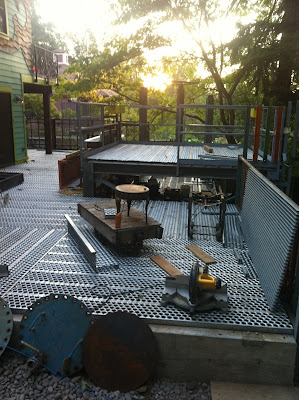
The metal on this deck was salvaged from an abandoned paper mill.

Nancy, the owner of this piece of modern art meets folk architecture, is a forensic accountant by day who collects salvaged materials and reuses them in her own home. In order to build safe structures out of her discovered materials, she employs a design/build firm to work out planning issues and get proper permits.

While most people have to worry about silly things like neighbors, mortgages, and subdivision rules and regulations, Nancy is afforded more leniency in her ever evolving art project. Because she owns her own house and isn't concerned with resale value, she doesn't have to answer to anybody. And because she lives in a city that is open to just about every alternative lifestyle choice you can imagine, her house is viewed by neighbors as a part of the community instead of something that is going to drive property values down.

Place in PDX
Exterior shot of the deck
Place in PDX
Exterior shot of the side of the house

She has such artistic freedom with her home that in one of her blog entries she states that she wants the casual observer to think that her deck is actually a junkyard. In reality, each piece of found or salvaged material plays an integral role not only in making the place come together, but in maintaining sustainability and living by the motto of "Keep Portland Weird."

Her entire design philosophy is based on being mindful of consumption, being sustainable, and remodeling the green way. You can find more information about her hobby on her website Re: Place in PDX.


Place in PDX Place in PDX
Vintage doors replaced the hollowed core doors that came with the house

Place in PDX
A customized railing installed after a nasty spill down the stairs
Place in PDX
A good portion of the house is covered with tile fragments